Free suicide cleanup tool
Suicide Cleanup DIY or Call a Pro? Risk Check
Eight yes-or-no questions that produce a risk level and explain when professional help is the safer choice.
Almost every family asks some form of the same question in the first hours. Can we just take care of it ourselves? The urge makes sense. It feels private. It feels like something you can do for the person you lost. It also avoids bringing strangers into the house. This risk check walks through a set of yes-or-no questions about the scene. Are blood or body fluids present? Are the materials soft and absorbent? Is the area bigger than a small spot? Could sharp items or chemical residue be involved? Is anyone who would do the work grieving the person who died? It gives a risk level and a plain reason why professional help is usually the safer choice.
The answer is nearly always to call a professional, and the tool is honest about that from the start. Federal rules under 29 CFR 1910.1030 treat blood and other body fluids as able to spread disease. A household has no protective gear, disinfectants, or waste path that fit the task. Just as important, the risk check names the mental hazard. Cleaning up after a loved one creates images that many people carry for years. If your situation somehow comes out at a low risk level, the tool still explains what would need to be true for that to hold. It also says what to do if things turn out different than you thought.
How to use it
- 1Answer each yes-or-no question from what officers told you or what you saw from the doorway. Never go into the room.
- 2Answer the question about how close the person doing the work was to the one who died. That is a real risk, not a small detail.
- 3Read the risk level and the reason together. The reason matters more than the label.
- 4If the result says to get professional help, go to the Provider Vetting Checklist. If it does not, read the assumptions again before you act.
Prefer to ask a person?
Your request is sent to the follow-up inbox. A coordinator can reply by email. Not for emergencies; call 911 first if anyone is in danger.
Check whether DIY is safe
Suicide Cleanup: DIY or call a pro?
Eight yes-or-no questions. The result is an educational risk level, not a safety clearance.
1. Is there blood, body fluid, or anything that could carry a bloodborne pathogen?
2. Has the material soaked into carpet, padding, a mattress, drywall or a subfloor?
3. Is there a strong or lingering odor?
4. Could needles, broken glass, drug residue or unknown chemicals be present?
5. Does the affected area cover more than a small spot, or more than one room?
6. Will children, older adults, pregnant people or anyone immunocompromised use the space afterward?
7. Do you need documentation for insurance, a landlord, a sale, or an estate?
8. Would you be doing this while grieving, exhausted or under time pressure?
8 questions left to answer.
A worked example
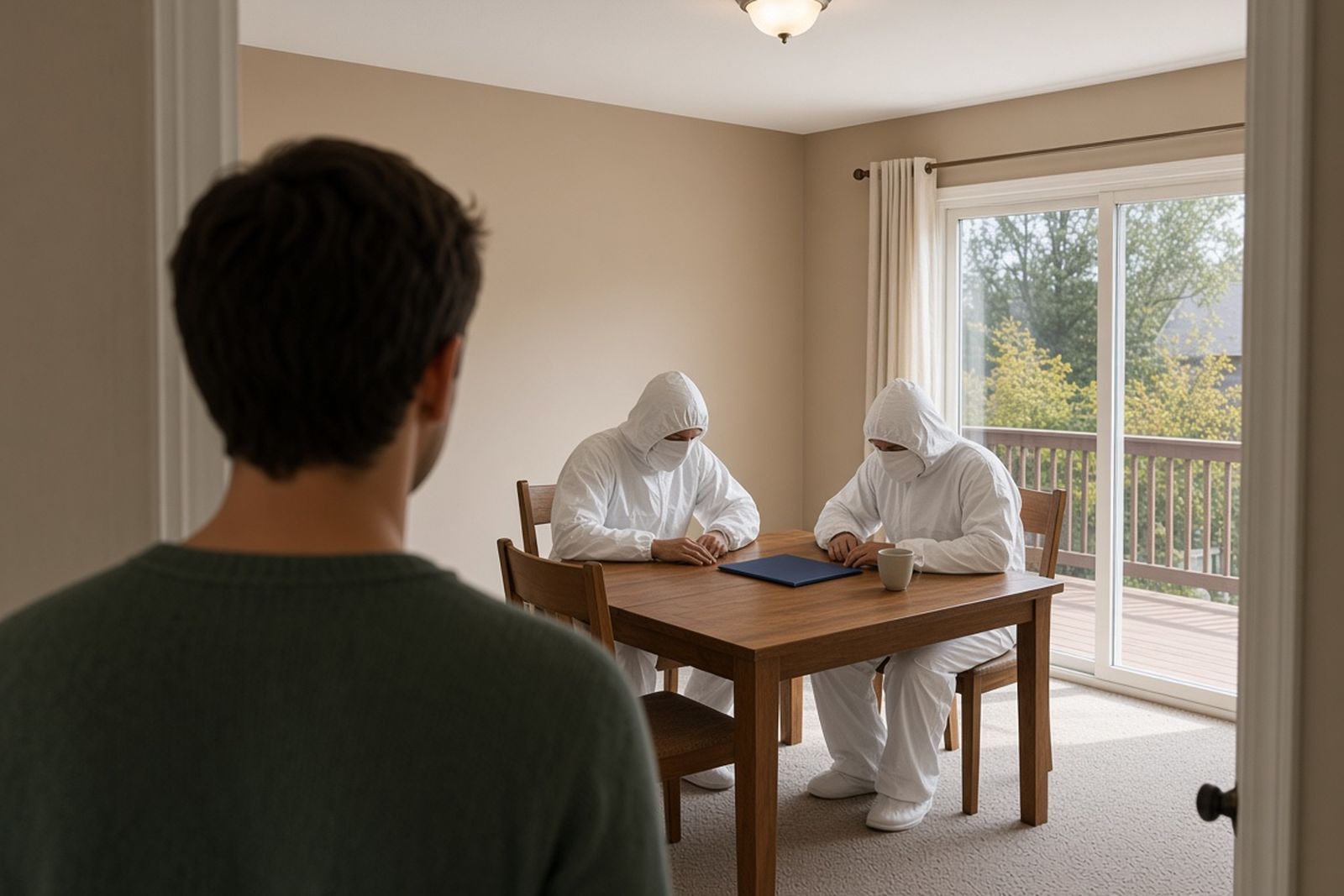
Here is a made-up case. A week after losing his teenage son, a father tells his brother he plans to clean the bedroom himself that weekend. He cannot stand the thought of strangers in it. The brother does not want to argue. He opens the risk check with him at the kitchen table. They answer that blood is present. The carpet and bedding are soft and absorbent. The area is bigger than a small spot. Sharp items are possible because a lamp was broken. No chemical residue was mentioned. The home has a pet. The person doing the work is a close family member, and no protective gear is on hand. The tool gives a high risk level. Its reason covers the risk of infection from dried material. It explains that soaked carpet pad cannot be disinfected in place. It notes the risk of cuts from glass you cannot see. It also says plainly that a parent cleaning a child's room can cause lasting harm. The brother reads that last part out loud. The father does not agree right away. But he agrees to let his brother make the calls. The next morning, the risk check result becomes the first item in their talk about the vetting checklist.
Numbers behind diy risk check decisions
- 48,824
Suicide was responsible for 48,824 deaths in the United States in 2024.
Read with care: Final 2024 mortality data; some deaths of undetermined intent are excluded.
Source: CDC (2024)United States, 2024, death certificates
- 71.3%
In 2021, 71.3% of NVDRS-recorded suicides occurred in a house or apartment and 54.3% involved a firearm.
Read with care: Earlier year; use as trend confirmation with the 2022 figure.
Source: CDC (2021)United States, 48 states, DC and Puerto Rico, 2021
- 11,453
Suffocation (including hanging) accounted for 11,453 U.S. suicide deaths and poisoning for 5,651 in 2024.
Read with care: Poisoning includes drug overdoses classified as intentional.
Source: CDC National Center for Health Statistics (2024)United States, 2024, death certificates
- 52.5%
NVDRS recorded 44,917 suicides in 2022, 52.5% of them involving a firearm.
Read with care: NVDRS links death certificates, coroner/medical examiner and police reports; 2022 is the first year with all 50 states, and location is recorded for the injury site, not always the residence of the decedent.
Source: CDC (2022)United States, 50 states, DC and Puerto Rico, 2022
These figures are public research and agency data, not this network's own job records. Keep each number with its population, year and limits; none of them predicts cost, timing or outcome at a specific property.
DIY or Call a Pro? Risk Check questions for suicide cleanup
Is it ever safe for a family to clean up after a suicide themselves?
Rarely, and only when no blood or bodily fluids are involved, the area is non-porous, and the person doing it is not emotionally connected to the loss. Even then, the risk check will point out the assumptions being made. For any scene involving blood, the combination of infection exposure and psychological harm makes trained help the safer path. The cost of getting it wrong is high and lasting.
Why does the tool ask whether the person doing the cleanup knew the deceased?
Because it is one of the strongest predictors of harm. Physical hazards can be managed with equipment; the images and memories formed while cleaning a loved one's room cannot be undone. Grief also impairs judgment about safety in the moment. The question is not a test of strength. It is a reminder that protecting yourself from that experience is a legitimate reason to let someone else do the work.
What if there is no blood, only a small area, and everything is hard surface?
The tool may give a lower risk level in that case, but read the reason carefully. It will note that the mess often goes beyond what you can see. It will note that chemical residue can be there without being obvious. It will also note that a professional visit costs little compared with the harm of guessing wrong. If you go ahead, follow the study guide's advice on sealing off the area and disinfecting. Stop if anything unexpected turns up.
Can I use a household cleaner or bleach if I decide to do it anyway?
Household products cannot replace an EPA-registered disinfectant that is rated for bloodborne germs. Bleach can damage surfaces and create fumes in a closed room. More important, spraying over dried material sets it in place. It also does nothing for anything that soaked into floors or fabric. The risk check explains this so that any choice you make is based on the facts, not on the feeling.
The result says high risk but the landlord wants the unit cleaned this week. What now?
Share the risk check result with the landlord. Explain that trained cleanup is faster and better recorded than a family attempt, which protects the landlord too. Use the Provider Vetting Checklist to find a crew. Ask the landlord to confirm in writing who approves the work. Timelines can be worked out. Exposure and lasting harm cannot be undone. Rules vary by state and county, so check what tenants must do where you live.
If a different relative will clean, or several days pass, does my earlier result still apply?
Not always, so run the check again. Your answers can change if someone other than you would do the work. They can change if more time has passed and fluids or odor have spread further into the floor. They can also change if you learn the affected area is bigger than it first seemed. A result that moves toward higher risk is a sign to stop and talk with a professional first.
Can I share my result with a relative who wants to clean the room?
Yes, and it can be a helpful way to start a difficult conversation. Sharing the result shows the specific risks rather than just your opinion, which may make it easier for a relative to hear. You might also invite them to take the check themselves. If they still want to proceed, encourage them to speak with a provider first and share information about 988 support.
Related community polls
Every count is a real visitor vote; nothing is seeded or padded. One vote per poll per device, and you can change your answer.
If you were coordinating cleanup after a suicide loss, who would you want to make the first call to a provider?
How important is it to you that a cleanup crew arrives in unmarked vehicles and plain clothing?
Other suicide cleanup tools
Cost Range Estimator
Set the affected area, surface types, severity and extras to see an educational cost range and the factors that move it.
OpenProvider Vetting Checklist
Fifteen questions to ask any remediation provider, a readiness score, and a copyable list of what is still unanswered.
OpenInsurance Claim Organizer
A guided checklist from finding the policy to tracking the carrier decision, with a printable summary of where the claim stands.
OpenFirst 24 Hours Planner
Tell the planner a few facts about the situation and get an ordered list of who to call, what not to touch, and what to photograph.
OpenWaste & Disposal Classifier
Five questions about the material point to the likely waste category and which authority to confirm the rules with.
OpenMore on suicide cleanup
Suicide Cleanup services
Learn what cleanup after a suicide loss involves. See how scene release, approval, disinfecting, belongings, and records all work to protect your family.
Costs explained
What drives the price, published cost ranges, and how to read a written quote line by line.
Insurance and payment
Which policies may respond, how to document a claim, and what to do if coverage is denied.
Community polls
See how other families handled privacy, insurance, staying home, and picking a provider after a suicide loss. Add your own view without giving your name.
Knowledge quiz
Check what you know about hazards, who can approve work, sealing off the room, disinfecting, waste, and records. This gentle quiz is for families and helpers.
Articles and resources
Read longer articles on helping people who lost someone to suicide, working with landlords and executors, and what caring, trauma-aware cleanup should look like.
Field guides
Step-by-step guides walk you through approval, privacy requests, insurance questions, and when to go back in after a suicide in a home or rental.